Sunday, September 20, 2015

Karin Gleason's #GACrewCall: Script Supervisor [20150917]

* I do not own this logo. It is owned by ABC's Grey's Anatomy
Nicole Rubio aka Nicole Cummins: Script Supervisor
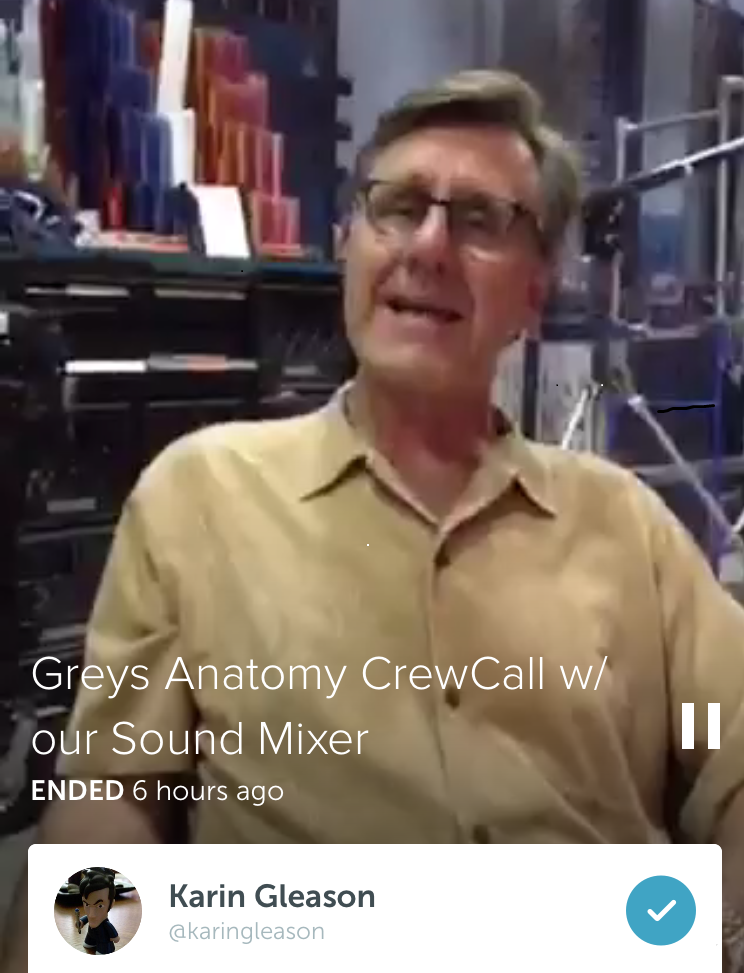
*Content written below is based on what was said directly from the periscope session in a mix of my words and his

Nicole Rubio is the script supervisor for Grey's Anatomy. She has been working on the show since the pilot re-shoots known to Karin Gleason as Season 1 episode 1.1. Nicole has also directed a few episodes (9.20, 10.18, 11.04, 12.04) and also plays Paramedic Nicole on the show. Karin Gleason and Nicole both state that they've been on the show for a long time. Nicole's daughter has grown up on Grey's, she was 3 when she started and is now 14.

According to Nicole the script supervisor "writes down everything that the camera shoots for the editor so that the editor can put it together later on." Nicole than proceeds to show a regular episode script (11.21) and then shows the script she does as script supervisor that consists of additional pages with copious amounts of notes. (Script notes consist of whether an actor didn't say this line, camera was out of focus there, ladder was in the shot here.) The completed script goes to the post department and music department so that they know exactly what lines were cut during shooting. Karin adds that "essentially she is the eyes and ears of post on set." Yes, she helps the directors and actors with lines and continuity, but because post can't be on set themselves, she is the one that is their on filming day that informs post of what decisions were made on set. She tells post what was good or bad of each take, or how the beginning of a take was good but not the end, etc.


Nicole states that in TV most editors can figure things out when it comes to events or changes on set, but with movies the script is almost twice as long as a TV script so the job of a script supervisor is the same but has a different rhythm and pace. With television even though the script is smaller than that of a film it is faster paced, all the shooting is completed in about 9 days. "TV is a condensed version of a feature." Also of all the other departments on set the script supervisor has almost no down time. For example, when actors are acting grips kind of sit around and when the lighting department is doing their thing actors have their down time, etc. However, script supervisor always has something to do, they don't get to sit around.

The script supervisor position is important because part of her job is to make sure all the shots needed for the day were done because they're not going back to pick it up. At the end of a day the set dresser and construction break down the set and prepare for the next scene. It's almost impossible to go back and fix, but sometimes re-shoots are needed. Nicole states that in 12 years that has only happened about 3 times.

How did you become a script supervisor?
She started in the business as an actor, she worked doing commercials and small parts. She was introduced to the position through a long time friend Dawn Gilliam who is the script supervisor for JJ Abrams. They met when Nicole was a Los Angeles Raiders cheerleader and Dawn was a Los Angeles Rams cheerleader. One day Nicole showed up for a job and Dawn was the script supervisor. After that Nicole thought "wow that is a really interesting job and I love all the responsibilities that you have and being able to sit, watch, and learn." Nicole then asked Dawn to show her the ropes and she learned on the set of Tales from the Hood (1995). After that producers got to know her and they hired her for their movie Sprung (1997) and she has been working ever since. Karin adds "it's an interesting job because you have to learn by doing, you have your task but you need to find your own rhythm to get things going." On Nicole's first solo job she didn't think she could do it but Dawn told her to give it time and that she just has to train her brain to be on all the time. She gave it time and formed her own system of doing the job. For example, while a camera lens is being changed you clean this up, tell that person a line, you come back you tell the sound department about a line change, go tell the property department that a cup in the shot was half full, and this and that until you get back to your chair and their rolling.

Having done acting, directing, and script supervising do you have a preference?
"They all excite me in different ways." Nicole then adds an anecdote of how she got the part as Paramedic Nicole. One day someone forgot to cast a paramedic and Executive Producer Rob Corn came into "video village" asking everyone to say the required line. Everyone was basically auditioning in video village and he even asked his 12 year old son he was so panicked and Nicole said the line and he was like "you're hired go do it." Even though she was working as an actor she was still running around doing her script supervisor duties once "cut" was called. It was also the day her catch phrase was birthed, whoa, whoa, whoa! (It was made clear that NO union violation were made)
*Photo Source
Do you find that being a script supervisor gives you another awareness of things?
Nicole states that she has been caught numerous times when directing giving lines to actors when they've forgotten it even though it's the script supervisor's job, that skill doesn't turn off. The attention to detail and communication skill that is required as a script supervisor is especially useful when dealing with someone who doesn't know their lines or needs guidance. She is trained to look at the lines, the action, and be aware of it all.

Do you think if you hadn't been script supervisor, if you had stayed being an actor, would you have segued into directing?
Being a script supervisor made her aware on set, but she was always interested in directing. Nicole describes that sometimes with being an actor you get pigeonholed. You get put into an "actor box," even though there are many actors who have directed successful productions. With all that said Nicole states that her answer is "I don't think I'd be directing if I was just still acting."
*Photo belongs to ABC & its affiliates
What are skills needed for the job?
In this job you have to be able to think for at least 18 hours a day, be organized, focused, be a people person, punctual, and jokingly have a strong bladder. Nicole states that your heart really has to be in it. She recommends that if you know anyone in the business that you shadow and intern not just her department, but all departments (hair & make-up, property, sound, etc)

How much did you like the flash mob episode (9.23)?
"It was the best!" It was long days with long rehearsals, but she was dancing alongside people who've danced with Michael Jackson. After it was done she was super sore, but she really liked it.


Best thing about your job?
Everything changes, the job is the same but everyday comes with a different situation and new way to deal with it. You never know what your going to get from guest actors, some are just amazing. The best part is the ever changing not knowing what you're going to get and being up for it.

Any advice for anyone trying to get into your profession?
Her advice is to learn it all, and keep it fresh. Learn all you can about all the working parts of a production. Also to explore all the different professions and people around you.

Where did you go to school?
Nicole did not go to film school. She learned all she knows while working on set. What you learn in film school she learned while on set as an actor and working with Dawn as a script supervisor.

At the end of the video Karin Gleason assures viewers that she will continue doing #GACrewCall sessions even after the premiere of the show and hopes to re-interview some of the crew to discuss things that couldn't be discussed before in order to prevent spoilers.

Thanks again to Karin Gleason and Nicole Rubio for their time today. Feel free to follow Karin Gleason on twitter at @karingleason for updates on future #GACrewCall sessions on periscope. You can also follow Nicole Rubio at @myfriendnicole or you can follow my random rants at @TheAmandaAponte! Feel free to leave comments below.


Tuesday, September 15, 2015

Karin Gleason's #GACrewCall: Unit Production Manager [20150910]

*I do not own this logo. It is owned by ABC's Grey's Anatomy
*I am not a professional writer and do not work for ABC, Grey's Anatomy, or anyone involved with this amazing show.

Chris Hayden: Unit Production Manager
*Content written below is based on what was said directly from the periscope session in a mix of my words and his.


This season of Grey's Anatomy (season 12) Chris Hayden has taken on the role of Unit Production Manager (UPM). The UPM "looks over budgets." They hold on to the budget and make sure the money is being spent wisely. It is a union job that falls under the Directors Guild of America (DGA).

Chris has been working on Grey's Anatomy for 12 years. He started working not on the original pilot but during the pilot re-shoots (when Justin Chambers was added to the cast). He has been working as an Assistant Director (AD) until this year when he became the UPM. He has also directed 2 episodes of Grey's Anatomy, one of which was split into two episodes ("Throwing It All Away" 10.15, "She's Leaving Home" 11.22) and is set to direct another episode in season 12.

How did you get into your field?
Chris was born and raised in Los Angeles, California. He majored in Philosophy from the University of California, Berkeley. He started doing entry level jobs in TV commercials. After doing that for a few years and getting into the DGA he worked as the 2nd assistant director on commercials then television shows. The first show he worked on was The Pretenders (NBC) for 3 seasons and then worked as 1st assistant director for a year. He also worked on The Shield (FX) for a few seasons and the movie Hustle and Flow until he got to where he is now.

How does being an AD differ from being a UPM?
Chris states that they are very different from each other. As an AD he is out with the crew working on set getting the shots needed for the episode and as the UPM he stays in his office looking at budget reports, reviewing where the network money is being spent. He looks over preliminary call sheets to see what money will be spent the following day such as wood, boards, linoleum, etc. He jokes how his job is the most glamorous on set. However, even though it isn't the most exciting job it is a necessary job. He states how his philosophy degree has helped him, western philosophy has lots to do with rigorous analytical thinking which has helped him in his job. As a UPM he supports the director by making sure they get what they need to get the best shots. He has to find the most efficient way to get the story told.

What are must have skills?
Chris states that you need to be analytical, logical, and have an easy to write signature to prevent writers cramp. He works closely with the accountant to crunch numbers but it would help to have knowledge/experience with budgets.

What is the best part of your job?
After so many years on set he has a bigger image of what goes on to make a project work. Chris recalls when he worked as a director, how he was so nervous and how different it was from what he has ever done before. He adds that he considers it a fun experience now that the episodes are done. He has worked on both the creative side of a production and now working on the efficiency side which all in all is what he considers the best part of his job, seeing all the working parts of a whole.

What is your favorite Grey's Anatomy episode?
Chris and Karin discuss how with so many episodes they all tend to blend. Chris states that despite how difficult it was to film he really enjoyed the Thanksgiving episode with Burke ("Thanks for the Memories 2.09) He really liked the bomb episodes ("It's the End of the World " 2.16, "As We Know It" 2.17) and working with executive producer Peter Horton. Another favorite was the two part ferry boat episodes ("Walk On Water" 3.15, "Drowning On Dry Land" 3.16). He adds an anecdote about a guy on set dressed as a firefighter that had his knee pop out of its socket. He was cool about the whole situation and had it popped back into place and came back to work the next day fine.


Any advice for someone wanting to go into your field?
Chris Hayden states that he never went to film school and he doesn't thing it is required. He states that in order to be proficient at something you have to do it everyday. It's something that needs continuous practice. His first job ever was a Sunkist commercial that a friend got him one day of work on. He knew that he didn't have experience on sets or had knowledge about equipment but what he did have was strength, he was smart, and he had hustle. He remembered how the other production assistance were telling him to slow down because they were making them look bad. But in this business you have to "up your game or get out of the way."

What was the most expensive episode?
It was determined that the gala event which so happens to be the 200th episode ("Puttin' On the Ritz" 10.04) was the most expensive stand-alone episode. It cost more because of the many extras, the circus performers, and formal wear cost more than street clothes. However the ferry boat episode was costly with the use of green screen and the extras but because it was a multi part episode they spread the budget between the episodes. The musical episode ("Song Beneath the Song" 7.18) was also costly because they had actors on set more time to rehearse, had to hire another team to manage the musical music, and a team to prerecord the music.

*I do not own this content. It is placed to show the viewer the content of the ep that made it costly.

Thanks again to Karin Gleason and Chris Hayden for their time on Thursday. Feel free to follow Karin Gleason on twitter at @karingleason for updates on future #GACrewCall sessions on periscope or you can follow my random rants at @TheAmandaAponte! (Does not look like Chris has a twitter or social media account.) AND don't forget to watch Grey's Anatomy's season 12 premiere on September 24th on ABC.


Friday, September 4, 2015

Karin Gleason's #GACrewCall: Property Master Angela Whiting [20150903]

*I do not own this logo. It is owned by ABC's Grey's Anatomy
*I am not a professional writer and do not work for ABC, Grey's Anatomy, or anyone involved with this amazing show.

Angela Whiting: Property Master
*Content written below is based on what was said directly from the periscope session in a mix of my words and hers.
Angela is the property master for the ABC drama Grey's Anatomy. She began the job during season 2 after Ryan Blank moved on from Property Master to Video Playback Operator.

The most basic explanation for what a property master does is that they are in charge of everything that the actors touch. However, it is more involved than just that. The most incomprehensible things are props such as license plates, certain costume jewelry, food, pens, badges, watches, etc. Angela explains that when envisioning what props are needed for a scene you have to imagine the scene as a whole ("the world off the page"), not just the certain objects in a characters hands like a scalpel for surgery. For example, if actors are having a park picnic scene (imagine little Bailey's birthday party in ep 10.17) you have to imagine what is going on in the background. Like the people playing softball, or kids playing Frisbee, or someone walking a dog, or lady jogging with her ear buds and water bottle. You have to imagine and prepare for everything around the subject as well as the subject itself, and anticipate for things that can come up unexpectedly. For example, Angela states how one time "horse pucky" also known as horse feces was needed last minute for a scene she was working on and she had to get some (fortunately they were at a horse stable) and she scooped some up into a cooler and made it work. "The glamour never stops"
*Photos are brought to you  by Angela Whiting herself.

How did you become a prop master?
Angela states that, "I love the movies." She got a Bachelor of Fine Arts from the University of California, Santa Barbara and then moved to Los Angeles, California because she was fascinated by how movies were made, the physical production aspect of movies. In LA, "I worked doing everything except for wearing a sandwich board." She worked selling advertising for a trade paper, worked as an arts and entertainment journalist for a now defunct (no longer existing) paper, she worked for a talent representative and development company, and then eventually began working for a FOX producer, Robert Lawrence. Lawrence got Angela a job as a Production Assistant (PA) and there she met people who wanted to do props. They all banded together and figured out how to get into the props part of the film industry. In other words she knew she wanted to work in the film industry but just didn't know what part just yet until she started in props. Since her degree was an academic degree and she didn't have any production experience she did all she could to learn as much as possible about the collaborative process of filmmaking.

Karin Gleason then adds that when working at a lower production level, and work with so many people, a person can see all the aspects and learn what they don't want to do on set. This is exactly what happened with Angela. Robert Lawrence was a project developer and she knew that it wasn't what she wanted to be doing. After working for him for a few years she took time off to travel for six months to Australia and when she got back she got a call from him about a project that got green lit. She goes on explaining that even though you may not be working doing something your passionate about at the moment make it known what you do want to work on and you just might get that magical phone call to do it.

What are some must have skills for a Props Master?
Patience, flexibility, and imagination are some of the few things Angela highlighted. She goes on explaining that you have to be able to "role with the changes." Many of the props are the product of ideas made from different people (color, shape, size). Angela has to take the decisions and make things or have things made based on their wants and recommendations. Also when a situation arises you have to have "instantaneous problem solving" skills as well as know who to call when you need to have something made. Angela adds how some challenges arise when you have to create pus, mucus, or vomit and make it look as realistic as possible, but user friendly to where the cast and crew aren't cringing with the smell which is where the craftiness and imagination skills come in handy.

 "Props are a small piece of a bigger machine, props are there to tell the story and move the story forward. You have to make sure your piece of the story integrates seamlessly."

Do you have a favorite prop?
Angela states that she can't choose because she loves them all. Although, in this upcoming season there is one that she is very proud of (she can't say what it is but will tweet about it when it airs). Because a lot of the props are procured by shopping or having it manufactured she got so happy with this particular prop because she made it herself. She states how the fun props are the ones where you sit at your desk for hours trying to craft it; a combination of art, crafting, and writing.

*Photo brought to you by Angela Whiting

What is the best part of your job?
Angela states that their are three things that she loves most about her job. First, she loves how every day there is something different, every script is different. Sure, you come to the same place with the same stages but there is always a new obstacle to overcome. She also adds that it doubles as a downside because she never knows what's going to happen. Secondly, she loves the collaboration. She loves working with other people. "I take great pleasure in accomplishing goals with other people that are often complicated and pressure filled." Lastly, she loves representing the science. She explains how a few seasons ago there was scene in a stem cell lab where it was written in the script that a character (Dr. Alex Karev) was creating a trachea from stem cells [7.06]. However in the script all it said was "[Karev] was working in the stem cell lab." Therefore, Angela as well as Linda Klein (Medical Producer), Jason Gustafson (Special Effects Coordinator), and Nicole Cramer (Set Decorator) had to figure out what exactly he would do while "working in the lab" in order to make it as realistic as possible. They did tons of research and watched many TED Talks to figure out the phases of creating the trachea. About two weeks later she got a knock on her door from the doctor, "stem cell [trachea] guy," who she based the scene. She brought out the shoe box with the prop in it and showed it to him and he said "that's exactly how it looked in the lab." She takes the science seriously and for the actual doctor who pioneered the science to say her hot glue and clay made trachea looked real, it made her really happy. "That's a good day at the office."
*Photo belongs to ABC

How did you make the lifelike pigs used in a number of episodes?
Angela didn't make them herself she worked with a prosthetic company (Legacy Effects) to make it. They build big animatronic animals with organs to go inside. NO REAL ANIMALS ARE HARMED OR USED IN THE MAKING OF THE EPISODES (It's in the credits). She also makes a point to add that all the animal actions are made shot by shot. If a shot requires the animal to breathe in a scene that is the main focus in the shot, same thing if it needs to bleed or make any type of movement, they don't need to make every action all at the same time.


Do you work closely with the medical producer?
Yes, both her and Linda Klein meet to find out what body parts are needed for each medical procedure scene (shredded kidney, necrotic bowel, etc.). There is a production meeting and then a medical props meeting to go through all the action that will go on in the episode to make sure everything is as accurate as possible. Other departments are looped into that meeting such as special effects and set decoration. "It takes a village"
*Images below are brought to you by Angela Whiting .

What is some advice you'd give someone wanting to go in your profession?
To immerse yourself in the culture. All of it encompasses culture as a whole so she recommends getting knowledgeable in history, architecture, pop culture, understand character, read books, listen to storytelling podcasts, and listen to music because it tells stories as well. You don't necessarily have to have a passion for every aspect of the job or specifics but love it as a whole. She references Mimi Melgaard (costume designer) when she says this job isn't for the faint at heart. It's really hard work, you really have to love what you do in order to do it.

She uses shows like Game of Thrones (HBO), Downtown Abbey, and Mad Men (AMC) to explain how all the things she mentioned would be needed since you have to envision that time period and that particular world. What tools would they use? What are their weapons? What did they eat off of? What did they drink from? What kind of furniture did they use in that time period? "It's good to know a lot, as much as you can."

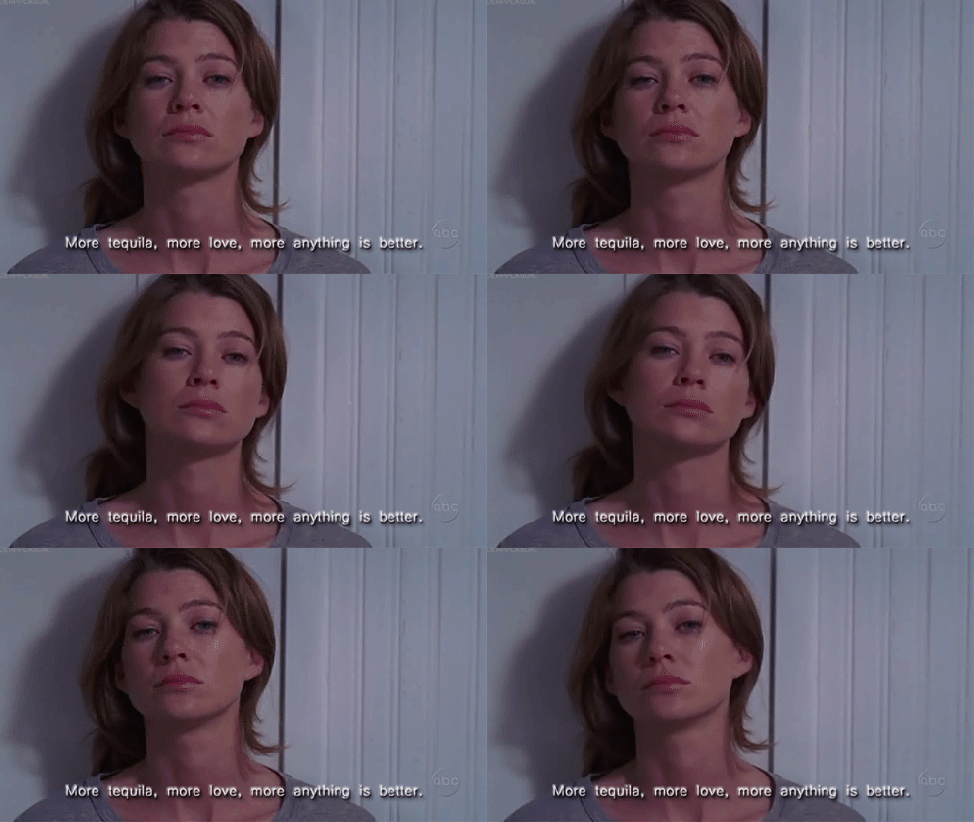
What is the tequila made out of on the show?
It is made of iced tea and water. It's a calorie free and caffeine free beverage. All liquor is made out of it because it most accurately depicts the actual color of the real beverage.  

Thanks again to Karin Gleason and Angela Whiting for their time today. Feel free to follow Karin Gleason on twitter at @karingleason for updates on future #GACrewCall sessions on periscope. You can also follow the talented Angela Whiting at @GreysProps  to see the MANY awesome prop photos or you can follow my random rants at @TheAmandaAponte! Feel free to leave comments below.

*Below is a video Angela did years ago showing the many props on Grey's Anatomy. I do not own the video. It is used solely for educational purposes.

Grey's Anatomy Props Department by Schokowutz

Saturday, August 29, 2015

Karin Gleason's #GACrewCall: Production Designer Brian Harms [20150827]

*I do not own this logo. It is owned by ABC's Grey's Anatomy
*I am not a professional writer and do not work for ABC, Grey's Anatomy, or anyone involved with this amazing show. (one day-fingers crossed*)

Brian Harms: Production Designer
*Content written below is based on what was said directly from the periscope session in a mix of my words and his.
 
Brian is the production designer for the ABC drama series Grey's Anatomy. According to the periscope session he has been working on Grey's Anatomy since season 6 under the title art director and just this season he has the new title of production designer. Harms states that the production designer is one part of the umbrella title "art department." The art department consists of the production designer, art designer, set designer, and art coordinator. The role of the production designer is to oversee and coordinate all efforts of the construction department, paint department, coordinate rigging grips, coordinate rigging electric, set dressing, set deck, props, and wardrobe. He is also in charge of creating the logos of the made up businesses of the show and he is also responsible for the logos for the jackets worn by the crew.

Additionally, Harms provides technical support for other departments. For example, we learned last week by Mimi Melgaard (costume designer of Grey's Anatomy) that she keeps multiples of the same outfits for multiple takes, and the same goes for the popular scrub caps the actors wear on the show. Character Derek Shepherd wears a very popular ferry boat scrub cap. Well, they only had one, and the fabric to make more was discontinued. So Brian Harms had the scrub cap disassembled. Then he scanned the cap into his computer, photoshopped and cleaned up the image in order to send out to print new fabric so that more caps can be made. Do you realize what that means? Brian Harms was the person who saved the ferry boat scrub cap and allowed it to live many more days on the show. As you saw at the end of season 11 even though Derek Shepherd is gone, Meredith Grey is keeping his spirit alive by wearing that famous cap herself. "It's a beautiful day to save lives"
*I do not own these photos. Belong to ABC's Grey's Anatomy
What's the difference between an art director and a production designer?
The top position for the art department is Art Director. It has its own union, Art Directors Guild (ADG). In order to be allowed to use the title "production designer," it has to be petitioned to the ADG. "It is a protected honorary title." Contractually not every show or production needs a production designer because the needed tasks can be managed by one art director. Since Grey's Anatomy is such a large show with so many components it requires both titles, an art director and a production designer.
*If you want to learn more about the two positions the ADG website goes in detail on the two jobs. A link to the direct page for the info is here.

How did you come to this job?
Harms explains that being born in such a small town (Lander, Wyoming) he didn't know that what he's been doing for years was an option, he didn't know what to do for a career. He knew that he had to go to college, but he didn't know for what so he ended up going to school for business since that's what he was told most people were doing. He started as a business major, then biology resources (with a goal of a career as fish and game officer or Forrest Services). Then he ended up getting a music scholarship (for voice & saxophone). He started working in the recording studio, then doing sound for theater, then sound reinforcement. When it was realized that his dad was a wood working teacher he was asked to work part time at the scene shop, he then started working for a touring company doing national tours as a technical director. He was doing all this while still going to school. He realized he liked what he was doing so much that he got his Bachelors of Fine Arts in Theater. Later he decided to go to grad school getting his Master of Fine Arts in theater scenic design. John Shaffner, (University of Montana alum and award winning art director for his work on shows like George Lopez and The Big Bang Theory) after Harms worked as an assistant on some of his projects, invited Harms to move out to Los Angeles to work. Not ready to take the plunge he didn't go, but 10 years later after getting his Masters he decided that he was ready. He ended up never working for Shaffner, but because Shaffner introduced him to people in the business he was able to get jobs here and there and hustled doing many non-union jobs until he got to where he is now. Brian Harms got his Associates of Arts from Central Wyoming College, his Bachelors of Fine Arts from the University of Montana, and his Masters of Fine Arts from Pennsylvania State University.

What are some skills that are needed to be a production designer?
"Every show is different and requires something different of you." Harms states that so much of the job is logistics, thinking something through ("what is it going to take to accomplish this objective"). Karin Gleason adds that if a tough situation arises it's not about knowing how to make everything happen, you have to know where to do the research to attack the task at hand. You also need a solid grasp of architecture, decorating, and style. Brian Harms makes an emphasis on how a portion of the job is script analysis (discussing characters), which his past work in theater and classes he's taken in acting and directing has helped him do.

What is the best part of your job?
"Most of us must be masochists, because it's such a tough environment with very long days." Harms contributes his co workers as one of the best parts of his job. The people he works with makes the job a lot better then what it seems. Some of the people he has worked with have become his best friends. Another great aspect of his job is feeling "the elation of the achievement [of overcoming a tough situation and] how it keeps us coming back for more." See, part of his job is getting put in situations that almost seem impossible, they have to figure out how to make things work in an unbelievably small amount of time. Gleason adds that it's the joy of seeing something through from beginning, middle, to end. "Most people will never know what it took to make a Grey's Anatomy episode work," says Harms.

What advice would you give to someone trying to go into your same profession?
Harms jokingly states, "RUN!" This job requires you to have a real passion, not just a want to work for a giant hit show. You really have to like designing sets and be okay with doing things yourself, and be able to stick it out through hard lessons until you are entrusted with harder jobs, and earn a little more. It's a tough job because there are no straight paths to get you to the job you want like maybe a career as a lawyer or a doctor. Brian Harms recommends an internship the Art Directors Guild offers, check out their website for more information: http://www.adg.org/

What is a favorite set you designed for the show?
Since his favorite set is in the unaired season 12 Harms couldn't answer the question, but Karin Gleason promises to come back to the question and answer it in the future. However, he did say that one of his favorite accomplishments would have to be his hospital logos he designed and his graphic arts work. He considers it to be a hobby different from his day-to-day art direction duties. For example when Seattle Grace hospital was getting rebranded during the merger he was struggling with trying to make up a good logo for Seattle Grace Mercy West. It was such an impossibly long name with too many words. However despite the struggle he made many versions and presented the pages to Shonda Rhimes and Rob Corn and a logo was chosen.

*I do not own this photo.

Thanks again to Karin Gleason and Brian Harms for their time on this weeks session. Feel free to follow Karin Gleason on twitter at @karingleason for updates on future #GACrewCall sessions on periscope. You can also follow Brian Harms at @HarmsDesign or you can follow my random rants at @TheAmandaAponte! Feel free to leave comments below.

Thursday, August 20, 2015

Karin Gleason's #GACrewCall: Costume Designer Mimi Melgaard [20150820]


*This logo belongs to ABC's Grey's Anatomy
*I am not a professional writer and do not work for ABC, Grey's Anatomy, or anyone involved with this amazing show. (one day-fingers crossed*)

Mimi Melgaard- Costume Designer
*Content written below is based on what was said directly from the periscope session in a mix of my words and hers.

Mimi is the costume designer for the ABC drama series Grey's Anatomy. According to the periscope session she has been working on Grey's Anatomy since the middle of episode 17 of season 2 aka "the bomb in the chest episode (2.17-As We Know It)." Her job as the costume designer is to read the script and figure out what the characters need, where the characters are going, and who the character is. The vision for the character depends on where Shonda Rhimes (show creator/executive producer) wants it to go. She then has 7 days to fit, alter, and then get it on screen.

How did you come to be a costume designer?
Melgaard states how she has always loved fashion, always loved clothes, and always loved how the clothes can help tell the story. Even when she was in school she knew that she wanted to be a costume designer. She has had jobs in theater, commercials, film (movies), and television. She does favor the pace of TV since she has so much energy to dedicate to it. Working on a film (movie) is slower because there is more time to pick out outfits for the characters. For example, when filming wedding scenes in TV despite how big the wedding may be she still has about 7 days to pick outfits for the bride and groom, as well as the outfits for all the guests that will be in the scenes.

What are some skills that are needed to be a Costume Designer?
It is very important to be super organized, have a really good work ethic, and you have to be good with managing a lot of different personalities. "Every artist has a different way of communicating." You also need to know where to get the research for whatever project that you are working on. For example, you need to know what people look like or do during the setting of the project whether it be a Western, a period piece (civil war, renaissance, etc.) or a present day project at the Mall of America in Minnesota.

How do you choose different types of outfits for the various cast members?
A wardrobe meeting is had to discuss the characters. In the meeting Melgaard discusses what she will need, and character details like where the character is coming from, who they are, what kind of person they are. The "wardrobe is an extension of the character." What the character does in the scene makes a difference to what she will need, for example if the scene has a vomiting or bloody component she will need more of the same outfit then usual since it will require multiple takes.

Best thing about your job?
"Coming to work [at Grey's Anatomy]." She states that even after almost 12 years of working on the show she can't wait to read the scripts to know what is going to happen next with the characters. To have so much excitement after so many years is a rare thing.

Any advice for those trying to work in your same profession?
The film business takes a special kind of person. You have to work really hard and be committed and open to hearing other people's points of view. You have to be committed to your own but listen to others. Melgaard states that you should take every job that you can, work for free if you have to or 1/2 price until you get to the point where you can charge full price. "Keep plugging along and eventually people will start hiring you"

Are you in charge of choosing the scrub caps for the show?
She is in charge of choosing the scrub caps. Melgaard chooses the fabric and then works with the actor and Shonda [Rhimes] to choose which one is the best for each character. The scrub caps are an extension of the character as well as all of the outfits, it's a part of the storytelling.

*I do not own this photo
Extra:
For those that asked the costume designer does keep the clothes from past seasons. They are kept in storage just in cases they are needed for a flashback in a future episode.

**Below is a video of an interview Mimi Melgaard did with the Curvy Cutie Gavin Pickens last year that showcases some beautiful dresses she picked out for past episodes.(http://thecurvycutie.com/greysanatomymimi/)


Thanks again to Karin Gleason and Mimi Melgaard for their time today. Feel free to follow Karin Gleason on twitter at @karingleason for updates on future #GACrewCall sessions on periscope. You can also follow the talented Mimi Melgaard at @MimiMelgaard or you can follow my random rants at @TheAmandaAponte! Feel free to leave comments below.


Thursday, August 13, 2015

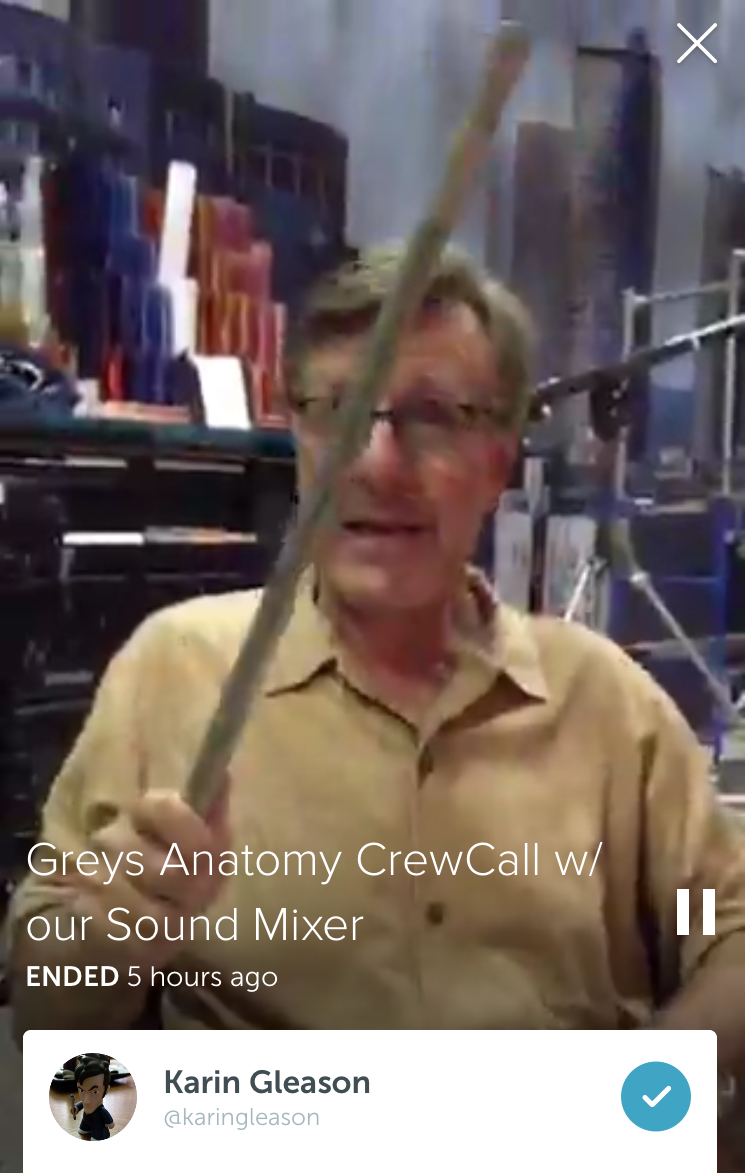
Karin Gleason's #GACrewCall: Production Sound Mixer Beau Baker [20150813]

*I do not own this logo. It is owned by ABC's Grey's Anatomy.

*I am not a professional writer and do not work for ABC, Grey's Anatomy, or anyone involved with this amazing show. (one day-fingers crossed*)


First I would like to apologize for not thinking about doing this for the first Periscope #GACrewCall for the 1st Assistant Director Annette Sutera. Only decided to do this after I saw a tweet on Twitter asking if someone was writing a synopsis/wrapup of the periscope interview for those who couldn't see it live or within its 24 hr window. Or for those awesome fans who came to join in on the fun later then the others (Better late than not at all, right?- sometimes).

On last weeks periscope session (from memory) 1st Assistant Director Annette Sutera discussed how she came into the position after first working for IBM with her engineering degree and feeling that it wasn't a fit for her. She has worked on the show for almost its entirety. Her job focuses on scheduling crew and actors among countless other things. Again, my apologies, feel free to add anything else in the comments that she discussed so I can add it in later.

Beau Baker- Production Sound Mixer
*Content written below is based on what was said directly from the periscope session in a mix of my words and his

Beaux is the production sound mixer for the ABC drama series Grey's Anatomy. He has been working on the show for 11 seasons (since Season 2). His job is to record actors speaking when they're being filmed by the camera. The main goal is to try to record the clearest sound for post production because in post it is easy to add sound to a scene but difficult to cut or separate the sounds. On his team he has a Mixer and 2 Boom operators that handle the boom poles that record the dialogue in the shots. He has been working for about 30 years in the business and 16 years as a mixer. He has worked all over the U.S. and has worked on a couple films in Europe. He is VERY appreciative of his job on Grey's because he can stay local and spend time with his family. Joke: "Never do a job that has midnight or snow in the title" and Grey's doesn't have either.

How did you make being a sound mixer a career decision?
As a USC (University of Southern California) film student he wanted to be a writer/director like many. He was fortunate to visit different film sets and the world of sound became very interesting to him. He was fortunate to start working with a well known sound mixer in his 20s and work with him on jobs that he had. When he started his career he traveled on jobs but when he started a family his main focus was to find jobs close to home.

Challenges of his job?
Some of the greater challenges of his job are (1) that the microphones can't be seen in the screen shots. "Have to be invisible to record their sound." Therefore, he has to be very particular about where mics are placed and hidden. Also (2) microphones "have no brains" so they pick up sound or dialogue that he wants but they also can pick up sound he doesn't want such as cars, background noise, equipment sounds, etc. The microphones can't differentiate what sound the mixer wants and doesn't want from the shot. The microphones have directionality so they can put them directly facing an actor or machine but it can't pick and choose the bits of sound that is trying to be collected on its own.

What determines which Microphone will be used?
If actors are standing at a nurses station or patient table the sound is recorded by microphones held over the actors on boom poles and cue the mic as they speak. If it's a scene where actors are walking & talking they wear small transmitter microphones hidden in their clothes. The action in the scene determines what mic is used in the shot. The goal is to minimize the outside noise as much as possible (engines, ambulance and police sirens)

*Different types of microphones


How was it working on the musical episode of Grey's Anatomy (7.18-Song Beneath The Song)?
That particular episode had people singing. The performers pre recorded their songs and during filming the music was played for them during each shot. A play-back operator was hired to manage the pre-recorded music. The most challenging thing was timing the dialogue perfectly to the pre recorded music. Actors wore ear wigs (costing ~$1,000 each) to hear the songs/music that way music wasn't being recorded while he was recording the background sound and dialogue.

How is the dialogue recorded during the surgical scenes when the actors are wearing masks?
The challenge in the operating room (OR) scenes are that on set, real medical equipment that makes noise such as the heart monitor and suction can interfere with the sound of the dialogue that is being said during filming. Sometimes he will do what is called a "wild track" (also known as wild sound or wild lines) which is when he has the actors run through their lines with the right timing but not actually have the camera rolling so he can focus on recording the dialogue. However, if need be actors do have to do ADR (automated dialogue replacement) to go back a record those particular lines. Because they are wearing masks it isn't as an arduous of a task because since their mouths are covered with the masks it isn't so time consuming trying to match their words to the movements of their previous recorded mouths. However, ADR is avoided when possible so that actors aren't taking more of their time to go to a studio and re-record their lines when so much of their time is already used while filming on set.

What are some must have skills as a sound mixer?
Focus on what it is you do or want to do. If your interested in sound focus on learning the sound. Same goes if you want to work as camera crew, make-up, set design, etc. Listen and learn. Working in film is a trade profession so you want to work with someone as an apprentice. Learn by doing it and watching it being done. All in all, you have to be attentive ("paying attention") and cheerful. You have to work long hours in sometimes hot, wet, cold conditions;" keep yourself happy in your work and you'll go far."


Favorite episode he worked on? (7.07-That's Me Trying)
There is a scene in the episode where there is a mass casualty trauma scene drill. In the scene there is lots of rain in the background and dialogue of the doctors treating the mannequins. He states that it's his favorite episode because despite the strong, loud rain and issues of wetting the microphones he was able to record all the sound during the 3-4 day shoot without requiring looping (another term for ADR). He states it "Was a very prideful moment in my life."

What is the best thing about your job?
Beau states that having two guys working with him on a team has been the best. They've worked together for awhile so they sort of become one entity when it comes to working together to get the task done. The other great thing about sound is he is part of the movie but not part of the "box" (metaphor for the whole scene and all the workers that make it up). So he doesn't have to worry about what others worry about such as if the sets are right, or if the wardrobe matches or other things like that. He works outside and independently of those kind of things. He is "not part of the world that we see, [he] is part of the world that we hear."

Any advice for those trying to work in your same profession?
What you need to do is work hard at finding what you don't know and learning what you don't know. He states that the benefits of today are that there are many ways to record, a regular cell phone is being used in the periscope video that many people are watching now. You don't have to find a film camera and buy the film like was the problem years ago. He states that tech is becoming more affordable, so learn the basics of audio with the affordable technology that is out in the world, if you network you can probably follow around someone or a teacher that that can teach you some things that you need to know. It is a trade craft so "you have to dive in the water and learn how to swim with it."

At the end of the interview he makes a point to thank Executive producer Rob Corn for hiring him. Creator Shonda Rhimes and the writers for writing amazing stuff and the cast for saying the amazing words that we listen to.

Feel free to follow Karin Gleason on twitter at @karinggleason for updates on future #GACrewCall sessions on Periscope. You can also follow Beau Baker at @beaumix or follow along to my random rants at @TheAmandaAponte! Feel free to leave comments below.


Friday, May 1, 2015

Grey's Anatomy: The Carousel Never Stops Turning...

Last night fans of Grey's Anatomy said their goodbyes to character Derek Shepherd on the episode "She's Leaving Home." However, the surprise of the episode was that only a small portion of the two hour long episode was dedicated to McDreamy's funeral. After watching the episode it's easy to see that creator Shonda Rhimes did an amazing thing with that 2 hour long episode that no fan could have imagined. Last nights episode was filled with insurmountable imagery and poetic introspection.

"She's Leaving Home" begins with Meredith telling a group of her friends and colleagues that "Derek is dead" and then passes out on the floor. Soon after it goes to character Dr. Owen Hunt telling Derek's sister of his death. Once Meredith wakes up she goes home and grabs her kids with flashbacks of herself as a child with her mom doing the same thing. What makes the episode great is its way of passing through a year of life with characters in different points of their lives while simultaneously having flashbacks of Ellis Grey (Meredith's mother), Meredith's dead husband, and her friends.

The episode is a compilation of its best sentences, a series of flashbacks, words that make the audience take an introspective look on life, do a little self-analysis just like Meredith's character is doing while remembering them all herself.

For example:
"It sucks being a grown up, but the carousel never stops turning. You can't get off." -Ellis Grey


This quote is one of the most popular from Grey's Anatomy. This is the quote that anyone can apply to life. Any grown up knows it is no walk in the park being a grown up, it's filled with life changing choices and never ending responsibility. You never want to grow up because being a child is such a simpler time. However, no matter how tough your life is illness, death, anything really life keeps going, it never stops. That is why you can't sulk, don't sit in sorrow, move on as quick as possible.


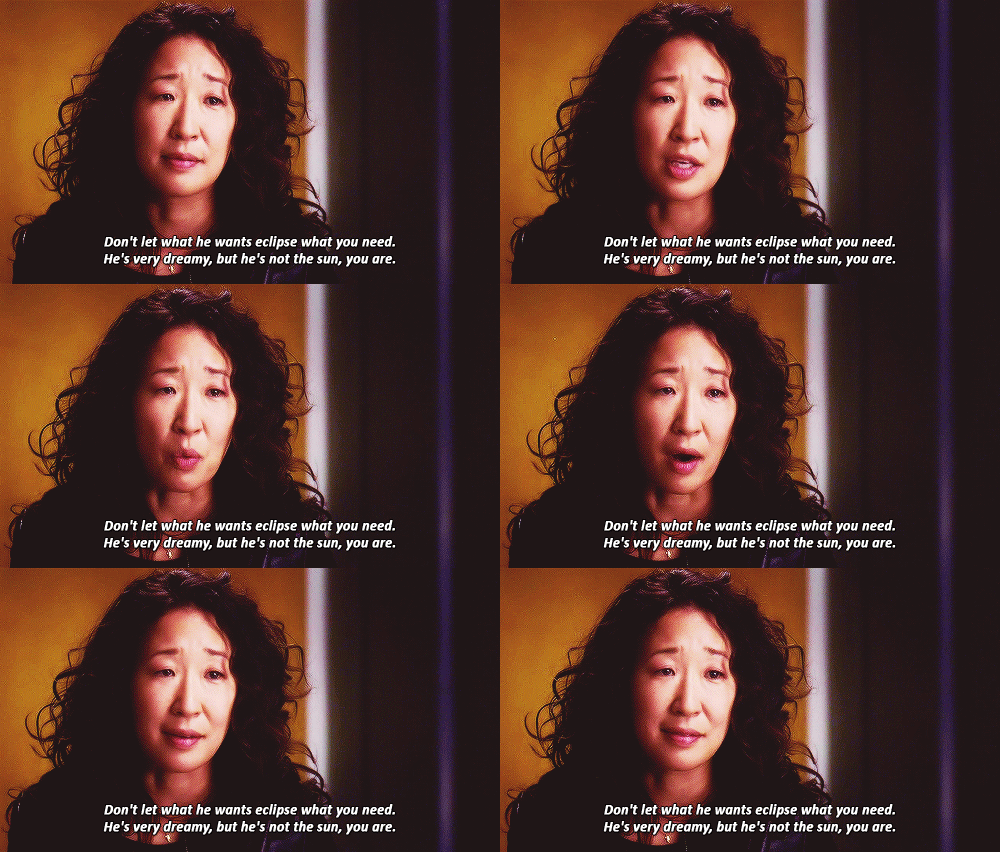
"He is very dreamy, but he is not the sun. You are." -Christina Yang

When Christina says this to Meredith it is about possibly following Derek to another state, and Christina wants Meredith to know that she is just as important or more than him. This can appeal to anyone in that sometimes in life you have to sacrifice things for a relationship whether it be for a spouse, significant other, and/or parent but sometimes you have to do some things for yourself. Your life is your universe, be the sun that the solar system revolves around. You are important and don't forget that. 

These are just a couple of quotes that make you self reflect on your life. The great thing about Grey's Anatomy is that the show is always like that. Audiences can find quotes through its 11 year run to re-evaluate your life. Walt Disney is quoted saying that "movies can and do have tremendous influence in shaping young lives in the realm of entertainment towards the ideals and objectives of normal adulthood." With that said last nights episode was the epitome of what Walt Disney stated, a great episode with a great fictional writing that can influences ones life for the better.